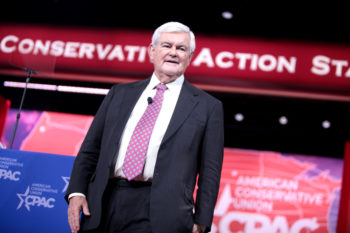
Newt Gingrich in 2015 (Credit: Gage Skidmore)
Since the middle of November, national polls of Republicans have shown Newt Gingrich the new front-runner for the GOP presidential nomination, with Gingrich now substantially ahead of Mitt Romney. But these polls are highly misleading.
As I’ve suggested before, national polls of Republicans can’t be trusted, because there is no national primary. Instead, the nomination process includes a series of state contests. And we know that results in the early states can have a profound effect on how candidates fare in subsequent contests.
We have to look at the early state contests to see where the candidates stand, if we’re going to rely on the polls as the major basis of determining a candidate’s potential viability. But even the polls in the early state contests cannot yet identify a sure frontrunner. Too many voters are undecided at this point to permit reliable predictions of the winners in Iowa, New Hampshire, South Carolina and Florida.
 If some political observers still view Romney as the leading GOP candidate, it’s not solely because he’s been toward the top of most polls, but rather because he appears to have a superior organization and a lot of money, as well as much establishment support. Even if he loses some early contests, he will probably have the money to continue his campaign over the long haul.
Right now, it’s not clear that any other candidate – including Gingrich as the currently poll-designated frontrunner – has the same capability to persist in the face of early losses. Gingrich may emerge as Romney’s main challenger, but it’s much too early to make that prediction now.
Here’s why…
Pollsters typically ask voters to indicate their preferences “if the election were held today.” Of course, the election is many weeks away for voters in the early contests (months away for voters in later primaries). Between now and when the election is actually held, what voters say today can easily morph into some quite different choice.
Still, if we want see which way the wind is blowing (and it’s a gentle breeze with shifting directions), we can look at some of the poll results in the early states.
Gingrich Leading in 3 of 4 Early Contests?
1. Iowa
In Iowa (where the vote is held Jan. 3), the latest polls show Gingrich with a double-digit lead over Romney. Still, the polls in that state are inherently unstable – measuring top-of-mind responses, rather than firm decisions. Also, it’s notoriously difficult to conduct accurate polls in caucus states – the number of voters who turn out is exceptionally small, and polls have a difficult time identifying who is actually going to participate.
Besides the difficulty of unreliable polls, there is the problem of timing. Until very recently, Romney has downplayed his campaign in that state. Now he is running his first ad there, and making a commitment to try to come in first. With an infusion of money and activity on Romney’s part, along with voter indecision, much can change in the polls.
Add to this the barrage of criticisms that frontrunners typically receive (see Ron Paul’s new ad, for example, accusing Gingrich of “serial hypocrisy”), Gingrich’s surge to so-called frontrunner status is not necessarily secure.
In that context, it’s important to keep in mind other candidates who could do well in Iowa – such as Ron Paul, who has consistently drawn double-digit support in that state, and who could well be a spoiler for either Gingrich or Romney. Also, it’s impossible to rule out new surges by Bachmann or Perry.
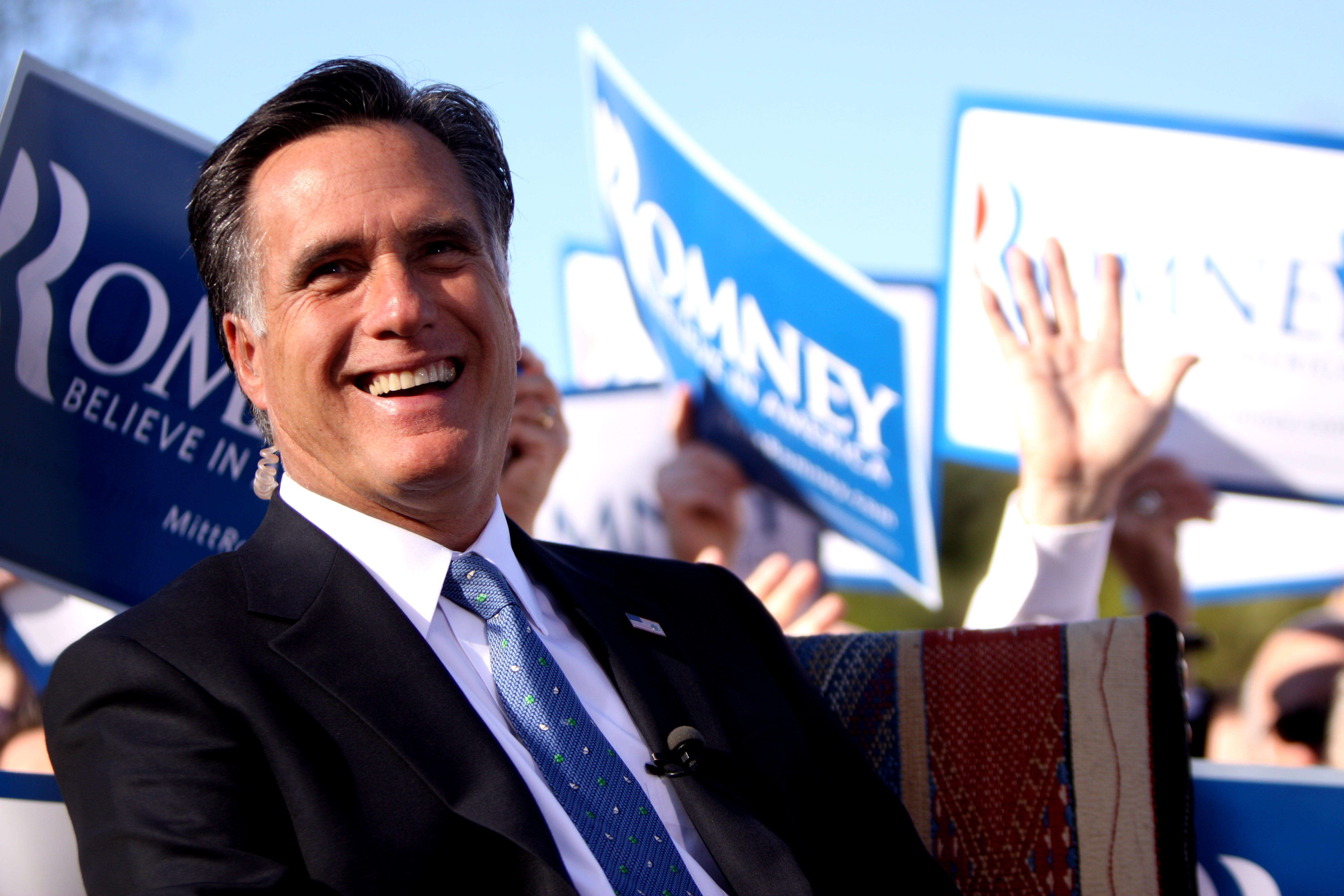
Mitt Romney (Credit: Wikipedia/Gage Skidmore)
2. New Hampshire
Romney is best positioned to win in New Hampshire (election on Jan. 10), having a substantial organization in the state, and being almost a favorite son candidate – given that he was governor of neighboring Massachusetts. In New Hampshire, the polls give Romney a substantial lead over Gingrich, anywhere from 10 to 27 points. Again, it’s worthwhile mentioning that, according to the recent UNH Survey Center poll, only 16% of the voters have definitely decided whom they will support, with 24% leaning toward a candidate and six in ten still trying to decide.
Typically, the results in Iowa have a substantial impact in New Hampshire. Granite State voters don’t always produce the same winners, but losers in Iowa often see their fortunes decline in New Hampshire, and Iowa winners usually surge. Romney can’t count on a victory in New Hampshire if he does poorly in Iowa.
3. South Carolina
In South Carolina (election on Jan. 21), the polls suggest Romney has a problem. Since August, it’s been Rick Perry, then Herman Cain, and now Gingrich who have been leading in the polls – with the exception of a few polls where Romney was essentially tied with either Perry or Cain.
Again, given widespread voter indecision, the first two contests could well reshuffle the order of candidate preferences in South Carolina. Should Romney win in the first two contests, that momentum could propel him to another victory 11 days later. On the other hand, a loss in Iowa and a poorer-than-expected showing in New Hampshire could give his opponent (whoever that happens to be) a leg-up in South Carolina.
4. Florida
Polls that try to measure support for candidates in the Florida Primary (election on Jan. 31) are almost meaningless at this point, because the dynamics of the campaign will inevitably be affected by which candidates emerge winners in the first three contests. Recent polling results in Florida show Gingrich with more than a 20-point lead over Romney but, in early November, polls showed Cain leading Romney by single digits. The wind can shift quickly.
New GOP Rule Could Prolong Campaign
The Republican National Committee adopted a new rule that could extend the nomination process compared with four years ago. It requires all states holding a primary or caucus before April 1 to award delegates on a proportional basis. That includes 30 states and the U.S. Virgin Islands. This rule means that even if a candidate wins the first four contests, his or her delegate vote count could be just slightly more than the delegates won by the second place finisher, and thus it will be difficult for any candidate to win an early decisive victory.
Also, the new schedule is much more drawn out than in previous years, with some of the largest states – New York, Pennsylvania, California, New Jersey and Ohio – holding their contests later in the season. This new calendar increases the probability of a long campaign.
And likely more misleading polls.
 |
David W. Moore is a Senior Fellow with the Carsey Institute at the University of New Hampshire. He is a former Vice President of the Gallup Organization and was a senior editor with the Gallup Poll for thirteen years. He is author of The Opinion Makers: An Insider Exposes the Truth Behind the Polls (Beacon, 2008; trade paperback edition, 2009). Publishers’ Weekly refers to it as a “succinct and damning critique…Keen and witty throughout