
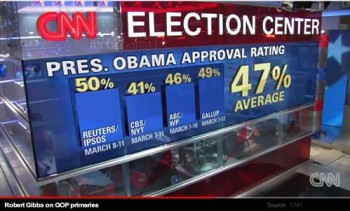
See above a screenshot from Cooper's segment. (Credit: CNN, screenshot)
COMMENTARY
 Selecting which facts to present in news stories is mostly a matter of judgment. Some alleged news organizations intentionally present biased information, while other news outlets claim to strive for objectivity.
The latter appears to be the position of CNN’s Anderson Cooper, and – one would hope – for legitimate news organizations more generally.
So, it was a surprise when I spotted that Cooper told a half-truth to one of his guests – a surprise not only because he committed the transgression, but also because his own network posted a graphic which exposed the deception!
Anderson Cooper’s Interview with Robert Gibbs
Cooper interviewed Robert Gibbs, President Obama’s senior campaign advisor, on March 13, the primary night for Alabama and Mississippi. Cooper asked Gibbs whether he would like to see Newt Gingrich and Rick Santorum remain in the GOP nomination race against Mitt Romney. Gibbs responded for a couple of minutes, saying there was little difference among the policy positions of the candidates, and concluded that “I don’t think that there’s a great distinguishing characteristic among all three of these.”
Cooper was waiting for Gibbs’ answer, so he could pounce with bad news about Obama’s latest approval rating, even though that had little to do with the original question he asked Gibbs or with Gibbs’ answer. But that didn’t prevent Cooper from pouncing anyway.
“And yet,” he said, “in a most recent New York Times/CBS News poll your candidate, President Obama, his job approval numbers have dropped significantly just in the last month. It was 50% last month and 41% of the people polled in this latest poll approve of the job that he is doing, 47% disapprove.”
Yes, Cooper’s statement is a bit incoherent, but more importantly it is deceptive, as ironically proven by Cooper’s own graphic, which showed the NYT/CBS poll as the exception among four recent polls.
The graphic (shown in this article) reveals that over the same time period of March 7-12, there were four polls that measured Obama’s approval rating: Reuters/Ipsos (50% approval rating), NYT/CBS (41%), ABC/Washington Post (46%), and Gallup (49%).
Clearly, the 41% approval rating was an outlier, significantly below the other three contemporaneous polls. In fact, Gallup reported that its latest rating was a new high for Obama – the opposite conclusion of the CBS/NYT report of a decline.
Why didn’t Cooper acknowledge the other three polls? Instead, he asserted as factual that Obama’s approval rating had declined significantly – when he had evidence that suggested the opposite conclusion was just as valid. (While the TV audience could see the graph, it was clear that Gibbs did not.)
I wrote to CNN asking the question: “Why did Anderson Cooper only mention the NYT/CBS poll when it is clear he knew of the other polls, and the one he cited was the outlier?”
CNN’s response:
“We displayed the results from other polls for viewers to clearly see there were multiple poll results, a point that was made in Mr. Gibbs’ response as well. Anderson gave plenty of time for Gibbs to discuss the polls and there was a fairly broad conversation on the topic that was respectful and informative for viewers.“
The response is a masterpiece of deception.
Yes, the viewers could see there were multiple poll results, but Gibbs could not. So to say that “Anderson gave plenty of time for Gibbs to discuss the polls” is a red herring. Also, Gibbs did say there were many polls and many results, but he wasn’t referring to the CNN graph, which he obviously didn’t see.
CNN simply refused to address the question I asked: Why did Cooper mention only the one poll to Gibbs and not the other three? It seems clear Cooper was not interested in discussing the actual state of public opinion, but was giving Gibbs a false picture of public opinion to see what his guest would say.
I wrote back to CNN and suggested that if Cooper had really wanted to engage in a “broad conversation on the topic that was respectful and informative for viewers,” he might have asked:
“What do you make of these four poll results, all taken within the same 5-day period? One shows a big decline in President Obama’s approval rating, three others suggest no change. Which do you think more accurately reflects where Obama is with the public?”
CNN did not comment on that suggestion.
Should reporters routinely engage in half-truths to fool their guests and mislead their audience? The answer seems so obvious, I wonder if we really need to spell it out.
Consciously withholding evidence that supports the other side of one’s argument is a distinct feature of advertising, entertainment and propaganda – but, I would argue, it is dishonesty in journalism.
This is not an earthshaking lapse in judgment. Instead, it is one of many small judgments that collectively produce what we viewers see as news. But if we see Cooper telling half-truths to guests about something as relatively inconsequential as poll results, and refusing to acknowledge what he did, can we trust him on larger issues?
No poll can answer that question.
 |
David W. Moore is a Senior Fellow with the Carsey Institute at the University of New Hampshire. He is a former Vice President of the Gallup Organization and was a senior editor with the Gallup Poll for thirteen years. He is author of The Opinion Makers: An Insider Exposes the Truth Behind the Polls (Beacon, 2008; trade paperback edition, 2009). Publishers’ Weekly refers to it as a “succinct and damning critique…Keen and witty throughout.”



Comments Terms and Conditions