
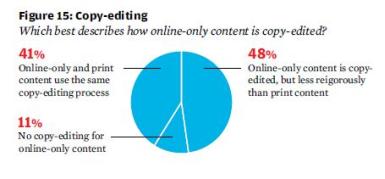
Perhaps ironically, a graph from Columbia Journalism Review's study states that only "48% Online-only content is copyedited, but less reigorously [sic]."
This week, the Columbia Journalism Review published the results of their survey of editorial practices at magazine Web sites (Web sites associated with a print magazine). The news was somewhat troubling in CJR‘s eyes, revealing that online work often gets much less fact-checking or copy editing than print.
But New York Magazine argues that study results shouldn’t necessarily be as “depressing” as CJR makes out. (StinkyJournalism wonders if New York Magazine participated in the survey, and if so, what did they say? Should this have been part of their critique of the CJR report?).
CJR‘s 34-question study (PDF) polled 665 magazines online about their editorial policies for print and Web content. The report highlights a number of important issues StinkyJournalism often looks for, like the presence of fact-checking, copy editing, and a publication’s policy for making corrections—do they correct transparently, or do errors or even whole stories just disappear? From the CJR report,
Copy editing (excluding blogs) is less rigorous online for more than half
(59%) of magazines surveyed (Fig. 15).
• 11% do no copy-editing for online-only content.
• 48% copy-edit online-only content, but less rigorously than print content.
• 41% use the same copy-editing process for online-only and print content.Fact-checking (excluding blogs) is less rigorous online than in print for 35%
of respondents (Fig. 19).
• 8% do not fact-check print or online content.
• 8% do not fact-check online-only content.
• 27% say online-only content is fact-checked, but less rigorously than print
content.
• 57% use the same fact-checking process for online-only and print content.Many magazines Web sites correct errors without acknowledging the
mistakes (Fig. 23).
• 87% correct minor errors, such as typos or misspellings, with no indication to
readers.
• 45% correct factual errors with no indication to readers.
• 37% correct factual errors and append an editor’s note detailing the nature of
the error to the content where the mistake appeared.
• 6% leave major factual errors in as they originally appeared in the content, but
add an editor’s note at the point of the error.
• 1% note all errors in a special section of the Web site.
Some of this does indeed sound pretty depressing.
But, in a March 2 post, Chris Rovzar writes at New York Magazine’s Daily Intel that context softens some of these blows. First off, the 665 sites surveyed by CJR may be more diverse than they are alike. “The main thing the sites surveyed by CJR have in common is that they have a print forebear. Otherwise, there are multiple approaches taken by magazine Web sites, from the almost totally blog-driven approach of the Atlantic to the slideshow-heavy Style.com,” Rovzar writes.
He also argues the standards of print magazines–fact-checking, copy editing, etc–may not necessarily apply to their Web extensions. “The key difference is that while print copy cannot be changed once it hits the presses, online copy can be corrected almost instantly,” he writes. “Does it really serve readers to acknowledge mundane spelling errors online when you can just fix them?”
But, as Rovzar also says, “There has been a robust debate about standards of editing and correction online for many years now.” His argument that online content requires less fact-checking and copy editing because it can be easily corrected only holds as long as those corrections are satisfying and sufficient for readers. Maybe it doesn’t serve readers to acknowledge mundane spelling errors. But CJR’s study also suggests more important errors could also be frequently disappeared away.
So, yes, the ability of online journalism to self-correct can replace some fact-checking and copy editing, but according to CJR, online corrections may still not be sufficiently replacing the full function of print corrections–both correcting and informing readers that there was an error in the first place.
For more, check out the full CJR study, and Rovzar’s post.