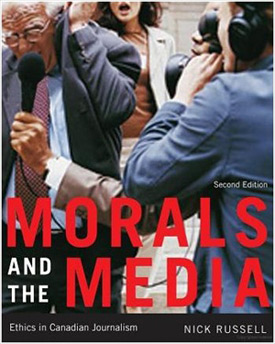
Morals and the Media: Ethics in Canadian Journalism. (Credit: UBC Press)
Morals and the Media: Ethics in Canadian Journalism, which describes itself as the “first book on Canadian journalism ethics,” focuses on English-language Canadian media and the ethical questions that those news outlets face.
Russell explained to iMediaEthics that he wrote the book “largely because I was shocked, as a Journalism teacher in Canada, to find (a) Journalism Ethics wasn’t being taught, and (b) ALL journalism texts were American.”
Morals and the Media was first published in 1994 and revised in 2006. Since its first edition, the book now includes recommendations for journalists on dealing with online media and the 24/7 news cycle including advising caution in reporting, avoiding hoaxes and the importance of original reporting.
Other additions to the book during its revision include “the whole Codes of Conduct section,” the book’s author, Nick Russell, told iMediaEthics. While “codes were scarcely on the radar” during the first edition, “by 2006 they were front-and-centre, not least because the Canadian Assn. of Journalists had, finally, developed a code (which I was very active in helping to happen).”
While Morals and the Media states that its audience is “students of journalism, working journalists and news consumers,” the book is a dry read and is most likely best used as a course journalism textbook rather than a reference book, like the Society of Professional Journalists’ recently revised ethics guidebook.
Each chapter ends with discussion questions.
He also noted the addition of the “Tough Calls” section since the book was being marketed as a journalism textbook.
Russell added he doesn’t think he will revise the book again because the book has “had (and still having) a remarkably good run, but next time it needs a whole new book, with different emphases. ”
“That didn’t matter a lot when it came to teaching the inverted pyramid, but it did matter considerably when it came to discussing investigative journalism (or Privacy, or Court-reporting, etc.). ] ”
To research the book, Russell pulled from his thirty years worth of clipping examples of both good and bad journalism, plus his work teaching and working in journalism. “It all coalesced into a year’s sabbatical from the University of Regina to the University of Wales, to write a PhD, which morphed into the book,” Russell explained.
Russell is currently working on a book titled Glorious Victorians: Celebrating Residential Architecture in the BC Capital, an illustrated study of houses. He explained that after he “took early retirement, I was able to expand my passion for heritage buildings.”
Q & A with Author:
iMediaEthics: In the five years since the revision, are there any other major issues do you think are worthy of inclusion?
Russell: “Journalism continues to evolve (as it always has, and should). Technology has made a big impact in the last decade. Blogging was new; Twitter and Crowd-sourcing didn’t exist then, and the concept that everybody’s opinion had value and should be heard hadn’t emerged. So, tastes and values also change: ‘Truthiness’ wasn’t a concept back then! Objectivity was still valued as a goal, albeit imperfect and unachievable.”
iMediaEthics: Checkbook journalism is a pretty hot ethical issue right now. The book noted that the influence of money and checkbook journalism isn’t as big as it is in the UK. Has that changed in recent years?
Russell: “Chequebook journalism is still not a big issue in Canada. (That may partly be because Canadian journalists don’t do as much investigative journalism, which in turn may be because there is not [quite] as much chicanery in high places, and because newsrooms have been gutted and budgets slashed.) Or it maybe because the cheque-writers haven’t been found out!
“The current News of the World debacle underlines the differences: Canada doesn’t have the high stakes (HUGE newspaper circulations [based on newsstand sales, not paid circ.], or the vicious competition. Regrettably, we’re almost all one-newspaper towns. ”
iMediaEthics: The book highlighted a couple of differences between Canadian and U.S. journalism ethics/issues, such as a stronger protection of privacy in Canada and the lack of a shield law in Canada. In your research for this book and work as a journalist, were there any other differences you consider noteworthy?
Russell: “The differences in privacy and shield laws just symbolize substantive cultural differences. After all, the ‘right to bear arms’ isn’t about guns, it’s about individuals vs. society. As a vast generalisation, Canadians have a greater respect for authority than Americans, and a greater concern for their neighbours. Whether or not these are a ‘good’ thing –they make us different. But the book isn’t about sociology (about which my Sociology friends would tell me I know nothing!)
iMediaEthics: What do you think are the most important ethical issues in Canada?
Russell: “The ego: Writer’s egos intrude everywhere, at every level: Opinionated commentators on TV and radio try to provoke audiences; “analysis” and “background” tags are on more “news” stories (and should be on many more!), and even the Globe & Mail now often insists on putting editorials on Page 1. Blogs proliferate, and even if some have value, the onslaught of wordage from all directions just adds to the babble.
“Desperation: Meanwhile, front pages are increasingly being treated simply as promos for what’s inside, so the line between tabloid and mainstream newspapers is blurred. The cost of production (and demand for profits), climbs, so newsrooms shrink and paper size shrinks, while the hunger to please advertisers escalates and reader costs rocket (I used to subscribe to four dailies, now it’s only two, and that’s still about $500 a year).
“Much of this can be laid squarely at the door of Conrad Black, who began it by acquiring then gutting both dailies and weeklies, and was completed by the Asper family, who bought the package and found they were way out of their depth in debt and values. This is exacerbated by the arrival of the “free” paper, which some readers evidently feel are a substitute for real papers. (Like “free advice” –it’s only worth what you pay for it?)”
“Bottom line,” Russell wrote, “It’s really hard to be ethical these days. Journalists are ill-paid, find they have to compete with quasi-journalists who have NO ethical vocabulary (the blogger who never went to J-School), and get NO support from management when they want to do some real journalism…especially about advertisers! Is this peculiar to Canada? Probably not.”
 Nick Russell, the author of Morals & the Media: Ethics in Canadian Journalism. (Credit: Univ. of Regina) |
Differences between Canadian and American Journalism Ethics
Morals and the Media highlights some differences between Canadian and American journalism as well as ethical guidelines. Canadian journalists don’t have any shield law to protect sources, whereas some U.S. states grant shield law protections to journalists.
According to Morals and the Media, when journalists are called to court to reveal sources, they are “rightly — treated as ordinary citizens,” which the book calls good because the journalists aren’t viewed as “privileged and set apart from the community on which they report.” (103)
When it comes to granting anonymity, Morals and the Media calls for journalists to share the information about the source with superiors so that more than one person bears responsibility for determining the source’s reliability.
“In general, Canadians may be more protective of individual privacy than their southern neighbours. And, logically, this may lead to the belief that the individual’s right to a fair trial outweighs the public’s right to know the lurid deals of that trial.” (xiii)
Also, Morals and the Media suggested that the media avoid naming the accused until a court has found someone guilty. (103)
Defining privacy as “the right not to be in the public eye…and therefore from media scrutiny,” Morals and the Media also focused on crossing the line by “publishing things that should be private” and “using unethical methods to invade privacy.” (141)
For example, Morals and the Media highlighted privacy in photo publication and noted how the media can invade the public’s privacy through photos of funerals, grief, accidents and more. Regarding funerals, “Morals and the Media” wondered if readers and viewers “have a right to attend such events by proxy.” (145)
As Morals and the Media noted, sometimes, like in the case of unusual accidents, private people end up in the news and the media may end up publishing photos or stories about people who ordinarily wouldn’t be in the newspaper.
To avoid invading privacy of those people and their families, Morals and the Media advised that photographers could frame photos to respect privacy. For example, photographers could take wide shots of these incidents instead of close- up shots in which “the photographer really has entered the family’s grieving space.”
Or, media outlets could refrain from publishing a photo or publish the photo or story deep in the newspaper as opposed to the front page. According to Morals and the Media, “because so much grief ends up on the front page, the public has a perception that the media thrive on it.” (147)
Morals and the Media cited Karen Sanders’ Ethics and Journalism book, which commented that “Privacy is probably the grayest moral area for journalists and unwanted publicity perhaps one of the greatest causes of suffering for ordinary people.” (143)
Morals and the Media also highlighted the correlation between how much privacy members of the public — celebrities included — receive and the amount of attention they seek. For example, the UK Royal Family doesn’t look for publicity so they are granted more privacy (148)
Morals and the Media also extended the privacy debate to reporting on the relative of public figures. And, as a rule of thumb, the book advised journalists apply the “reversibility rule” (151) to stories dealing with privacy invasion: Would journalists find the story invasive if that story was reported about them?
Money & Manipulation in Journalism
Morals and the Media highlighted the influence of money on media, but noted that checkbook journalism isn’t “widespread in Canada,” especially compared with the United Kingdom.
One noteworthy example of high-profile checkbook journalism in Canada listed is that of the Gerda Munsinger story, which was the “centre of a sex-and-security scandal.” Munsinger was reportedly “good friends with at least one cabinet minister,” but when someone asked about Munsinger, a justice minister claimed she had died. A Toronto Daily Star reporter found her, though, and paid $980 for her story, which would eventually have been revealed, according to Morals and the Media.
While her story reportedly was just interesting and without a criminal element, Morals and the Media noted the “danger” of bidding for sources and the result that sources will soon expect payment for their stories. (58)
Regarding journalists accepting gifts from sources, Morals and the Media commented that “it would be foolish to ban every gift of every nature and to let rule-obedience ruin friendships and the natural flow of relationships — insisting, for instance, on paying for a coffee offered casually in a source’s office. But real friends generally return the favour.” (66)
Morals and the Media also listed some ways the media can be manipulated, including through injunctions, press releases, staged photo ops, media events and news conferences and leaks.
Specifically, Morals and the Media advised journalists carefully “examine leaks from all angles” because they are “an attempt to get journalists to join the team — to make them allies, rather than enemies.”
Another way the media can be manipulated is through hoaxes both on the media and “on the community,” when people pose as journalists. Noteworthy hoaxes Morals and the Media mentioned included that of Orson Welles’ War of the Worlds, April 1 jokes, the fabrication scandals of Janet Cooke, Stephen Glass, and Jayson Blair, and staging or doctored photos.
Violence in Journalism
Morals and the Media noted that violence does have to be reported in the media because it exists in the world and “it is unrealistic to expect the media to clean up the world.” (161). But, the media has options in reporting on violence: for example, the media could write a story instead of publishing a graphic photo. Or, again, the media could run the photo on inside pages instead of on the front page.
Sometimes pictures are necessary to report the story, according to Media and the Morals. But, the media should use good taste in doing so. “This is not to suggest that we should eliminate conflict from the news menu or pretend it does not happen….hiding it doesn’t make it go away,” according to Morals and the Media. (162)
Concerning violence, crude images or words and other debatable stories or images news outlets may publish, Morals and the Media commented that:
“Nobody said journalism was easy. However, one old journalistic axiom is appropriate here. If in doubt, leave it out. It is often not a difficult decision simply to omit the potentially offensive words, pictures, or even entire article.” (170)
The book also features a section on how members of the public can get “redress” for media errors. For example, letters to the editor, blogging, commenting on stories online, legal action, axing subscriptions or viewership, and filing complaints with the CRTC or press ombudsman or councils.
Other Soundbytes and Advice
Often cited throughout Morals and the Media is its list of the “Five Ws and H of ethics.” The list is included as advice for making editorial decisions. Questions include:
- “Who gains or loses by this story? … Who is ultimately responsible?
- “What principles collide? What does it do for our/my credibility? (Will the audience think less of this newsroom for running these details? Can I look myself in the mirror tomorrow?) What has been newsroom practice in the past? What are the alternatives?
- “When should we publish this?”
- “Where should this story be published?”
- “Why withhold or run this? … Why is this source doing this?”
- “How was this material gathered?… How might the process affect the story? How was it corroborated for fairness and accuracy? How would the decision alter if the situation was reversed and I was on the receiving end?”
Morals and the Media advised both doing good as opposed to just not doing bad — what is dubbed “red light versus green light ethics.” (14)
Morals and the Media noted that “at best,” the press should try to “achieve a close proximity to truth.”
Morals and the Media also weighed in on “pack” and “celebrity” journalism. Pack journalism, as defined by Russell, is when multiple journalists report on the same stories and celebrity journalism isn’t reporting on celebrities, but when the journalist is the celebrity.
According to Morals and the Media, pack journalism happens because it’s “easy,” “fast,” and “self-confirming,” and can be good for new journalists as they learn “the ropes” of journalism. But, pack journalism doesn’t advance stories and is often repetitive.
Celebrity journalism, however, can be bad because, Russell writes, “it gets in the way of news.”