
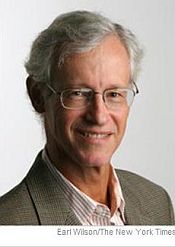
Arthur Brisbane, above, wrote his first column as the public editor of the New York Times on the danger of using "absolutes." (Credit: Earl Wilson/The New York Times)
The first column by Arthur Brisbane, The New York Times’ new (and fourth) public editor, focused on the often troubling use of “absolutes” – the claim that something is the most, the best, 100%, and so on. The three previous public editors have been Clark Hoyt, Byron Calame and Daniel Okrent.
Brisbane wrote that “a danger awaits stories that venture into the land of 100%.” He said, “Stories that report on something that is a ‘first,’ a ‘biggest,’ an ‘only; stories that employ ‘never,’ and stories that predict with absolute certainty are often headed for trouble.”
Citing specifically Gina Kolata’s Aug. 10 article in the Times’s health section, Brisbane found that the story’s headline, subhead and lead all suggested an absolute claim that the story failed to back up.
The article, “In Spinal Test, Early Warning on Alzheimer’s: 100% Accuracy Found in Study Results,” was based on a study in a forthcoming article in the Archives of Neurology. The study itself isn’t described until about two-thirds of the way through the article, though, as the article explains the state of Alzheimer’s research and researchers commenting on the study.
“The new study included more than 300 patients in their 70s, 114 with normal memories, 200 with memory problems and 102 with Alzheimer’s disease. Their spinal fluid was analyzed for amyloid beta, a protein fragment that forms plaques in the brain, and for tau, a protein that accumulates in dead and dying nerve cells in the brain. To avoid bias, the researchers analyzing the data did not know anything about the clinical status of the subjects. Also, the subjects were not told what the tests showed.
Gary Schwitzer, who publishes HealthNewsReview.org, a site which analyzes reports on health and medical news, critiqued the story at the time, calling the 100% accuracy statement both “misleading and unhelpful.” Schwitzer wrote about Brisbane’s first column, praising “Brisbane’s scrutiny of the story, limited though it may be.” Noting that The Times does “so much good,” Schwitzer wrote optimistically that perhaps Brisbane can help improve areas where The Times “could be so much better.”
Brisbane
The American Journalism Review’s fall 2010 issue features a profile of Brisbane, who will have a three-year term. The advance article, published on the AJR’s website, quoted Brisbane’s former bosses, the past public editor Clark Hoyt and The Times’ executive editor Bill Keller.
Brisbane “has the added advantage of having worked on both the editorial and business sides of newspapers. “He has a better sense of the audience than many journalists who have only been on one side of the fence,” according to Larry Kramer, who hired Brisbane in the 1980s.
“It’s a healthy check, and it’s a good way of explaining to the readers what we do in a more systematic way,” executive editor Bill Keller is quoted as saying. “But I’m not saying I enjoy it. It’s like a colonoscopy or a root canal.”
The AJR reported that Hoyt recommended Brisbane, who was named after his grandfather, William Randolph Heart’s top editor.
The three previous public editors “have hammered the Times on its use of anonymous sources,” The AJR wrote. As StinkyJournalism wrote in May, Hoyt wrote more than six columns addressing issues of sourcing within thirteen months.
“Having a public editor call us on that means that we try to police the subject regularly,” The AJR reported Keller said. “There’s a housekeeping function that happens more diligently when you have a public editor call you out in a column in your own paper.”
According to The New York Times’ biography of Brisbane, he has worked at New York newspaper The Glen Cove Guardian, The Washington Post, the Kansas City Times, and the Kansas City Star. He was The Star’s editor from 1992 to 1997, and in 1997 he was its publisher. In 2005, he was named a senior vice president for Knight Ridder, which owned the Star.
For the past few years, Brisbane has run his own consulting company, ASB Consulting, LLC, AJR wrote. But, “while ASB Consulting LCC still exists, Brisbane now works exclusively for the Times.”
UPDATE: 09/30/2010 11:26 AM EST: See an update on this story in our media briefs here.