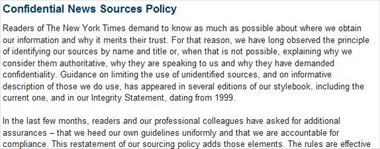
See above a detail of a screenshot from The New York Times's published policy on the use of confidential sources. (Credit: New York Times)
The New York Times’s standards editor, Phil Corbett, sent out an internal memo to the Times newsroom addressing the use of anonymous sources. The memo served as a reminder of The Times’s stringent anonymous sources policy and offered some tips for staffers using anonymous sources.
Ironically, it appears that an anonymous source leaked the confidential Times memo criticizing staffers use of anonymous sources.
Gawker first published the Aug 31 memo. Columbia Journalism Review blogged that “the memo was leaked (anonymously, ha) to Gawker.” Hamilton Nolan, who wrote the Gawker story and posted the memo, wrote in an e-mail to StinkyJournalism that he “got [the memo] from a source.” We asked for more information — was it a Times staffer for instance, and Nolan responded “Can’t say, sorry. It’s a source I’m confident in.”
Editor and Publisher also published The NY Times’s memo, and noted that The Times isn’t alone in failing to consistently properly identify why sources were granted anonymity. Many newspapers also don’t explain why the source was allowed to be anonymous.
But, the Times’s does have a strict printed policy available to the public advising its journalists of the rules for anonymous sources. See here The Times’s complete policy on the use of “confidential sources.” Is it excusable for The Times’ writers to not adhere to a stated, public policy governing reporting?
The memo serves as “another reminder and some new suggestions” about the use of anonymous sources. According to Corbett, “the most common problem actually involves one of the less crucial aspects of our guidelines- the question of what explanation, if any, we offer the reader for why a source wants to be anonymous.”
Not mentioned in the memo, but within The Times’s guidelines, is the Society of Professional Journalists’ code of ethics That ethics codes advises that journalists “identify sources whenever feasible. The public is entitled to as much information as possible on sources’ reliability.”
Also regarding anonymous sources, the SPJ’s ethics code advises to “Always question sources’ motives before promising anonymity. Clarify conditions attached to any promise made in exchange for information. Keep promises.”
“Nearly 300 times in the past year,” The Times‘s reports have explained sources wanted anonymity because they were “not authorized” to publicly comment, Corbett found.
Corbett criticizes the description that a source is anonymous because they want to be anonymous, they aren’t authorized to speak, or because the topic is of a sensitive nature. He explained that those descriptions aren’t good enough because they are “usually stating the obvious, and is of little or no help to a reader.”
Ideally, reporters should give a descriptive reason for the source’s request of anonymity — for example, “out of fear of retaliation from X,” “because the company has threatened to fire workers who speak to the press,” and so on. The Times should give as much information as possible – without identifying the source – so that readers can “judge the source’s credibility” and motivations, Corbett wrote.
The Times’s rules also require that “at least one editor must know the identity of an anonymous source.” Corbett noted that he does “occasional spot checks” to see if editors do actually know the source’s identity and that some sections of the paper have a “regular practice” where a note is attached to a story labeling which editor knows the source’s identity.
“As all our guidelines emphasize, we should resort to anonymous sources only for newsworthy information that we can’t report any other way. Anonymity should not be invoked for trivial, obvious or tangential information, or for quotes that add little of substance. And it should not be used as a mask for personal attacks,” Corbett added.
The leaked memo followed a discussion on anonymous sources at Clark Hoyt’s farewell dinner. Hoyt was The Times’s public editor for three years. His term ended in June, and Arthur Brisbane has been named the new public editor with a three-year term. (See StinkyJournalism’s coverage of Brisbane’s first column here, and our report on some of the criticism of The Times’s lack of diversity for the public editor position here.)
Hoyt often critiqued The Times’s sourcing. In May, he opined that The Times was “squandering” its readers trust by its constant and often unnecessary use of anonymous sources. That was his seventh column in 14 months calling out sourcing issues at the newspaper.
iMediaEthics wrote to The New York Times’ new public editor, Arthur Brisbane, asking if anonymous sources will be an area of focus in his critiques of The Times. We will update with any response.