

A researcher claims Wyeth, a drug manufacturer, hired ghostwriters to promote its products and de-emphasize the risk. (Credit: Flickr, MollyBennett)
A researcher claims that the drug manufacturer Wyeth hired a communications firm to write articles for medical journals that would benefit its company. In response, that communications firm, DesignWrite, claimed the researcher’s work is flawed and suggested she had a possible conflict of interest.
Researcher Dr. Adriane Fugh-Berman from Georgetown University Medical Center explained her claims in an article published in the Public Library of Science Medical’s peer-reviewed journal. She found that Wyeth hired DesignWrite, among other medical education and communication companies, to write about its Premarin products. Her study details the editorial process between DesignWrite and Wyeth, noting that:
“Between 1997 and 2003, DesignWrite’s output for Wyeth on the Premarin family of products included “over 50 peer-reviewed publications, more than 50 scientific abstracts and posters, journal supplements, internal white papers, slide kits, and symposia…”
According to Fugh-Berman, DesignWrite drafted articles, Wyeth made comments, “DesignWrite then incorporated Wyeth’s comments into a second draft, and sent the company-approved draft to the ‘author’;’ whose comments, if any, were incorporated into the third draft.” Finally, DesignWrite worked to get the papers into journals.
Fugh-Berman couldn’t determine that authors were paid, but she did find that Wyeth paid DesignWrite $25,000 for at least four “primary publications (articles that report clinical trials)” and $20,000 to $25,000 for at least 20 review articles. She explained that the ghostwriter was labeled “writer” and that the “author” would be the person whose name went on the paper. Fugh-Berman published part of an e-mail where an “author” questioned why she was only editing and not writing the article, to which the DesignWrite employee Karen Mittleman responded:
“The beauty of this process is that we become your postdocs! … We provide you with an outline that you review and suggest changes to. We then develop a draft from the final outline. You have complete editorial control of the paper, but we provide you with the materials to review/critique.”
Fugh-Berman’s problem with the articles is bias, not accuracy, Toronto Sun reported. The bias is that the articles were “downplaying the risks of the products they represent, and repeating the benefits.”
According to MSNBC, Fugh-Berman analyzed dozens of ghostwritten reviews and commentaries published in medical journals and journal supplements, many of them using documents from judicial trials.”
The journal Nature reports that DesignWrite had oversight on articles between 1997 and 2003. “The documents suggest a deep involvement in writing, editing and overseeing the publication of the papers, with sometimes only minimal involvement from the named authors.”
Pfizer responded in a statement published in full on CNN’s Sanjay Gupta’s blog highlighting that Fugh-Berman is “a paid expert witness for plaintiffs in hormone therapy litigation, and even with her critical perspective, she could not establish that there were inaccuracies in any of the peer reviewed articles, or that their authors relinquished control over their work.”
Pfizer further stated that the article doesn’t offer any new information and doesn’t note that Pfizer has changed its policy to emphasize more disclosure in medical writings.
“Most importantly, this article completely – and conveniently – ignores the fact that the published manuscripts were subjected to rigorous peer-review by outside experts on behalf of the medical journals that published them, and that their integrity and scientific rigor has even been recognized by multiple courts.”
Read the whole Pfizer statement here.
But, Fugh-Berman disclosed her role as a “paid expert witness” and that she wasn’t paid for “researching or writing” her article. She noted that the “recent litigation against Wyeth” represents more than 14,000 plaintiffs who developed breast cancer “while taking the menopausal hormone therapy Prempro.” She further stated that the PLoS Medicine and The New York Times had pushed for the documents to be made public.
She studied roughly 1,500 internal documents from Pfizer that became “public during litigation.” She claims “she found dozens of peer-reviewed articles prepared by ghostwriters.”
Widespread?
Fugh-Berman explained her article was not just to call out Wyeth, but to educate the doctors who write these articles about ghostwriting companies. The Toronto Sun reported that Fugh-Berman told QMI Agency that “ghostwriting in medical jouranlis is widespread,” and sometimes the authors of those articles don’t know they’re being used that way.
“They often don’t understand how the way something is written can affect the perception of the reader. Writers understand this, but doctors don’t always,” she is quoted as saying. “Marketing messages are quite subtle. It’s the way things are phrased.”
In response, The Toronto Sun reports that, since Feb. 2009, Pfizer “has publicly disclosed its financial relationships with physicians, medical organizations and patient advocacy groups.”
A Pfizer spokesperson further claimed that “Medical writing companies assisted authors only in drafting manuscripts, and authors themselves had total control of the content of these papers, which were always based on sound science.” The claim is seemingly contradicted by a DesignWrite e-mail published by the journal Nature.
Read Fugh-Berman’s article here.
(Just an aside, note MSNBC’s subhead spelling error in its report on Fugh-Berman’s article).
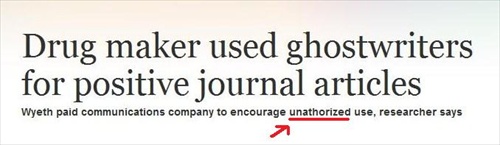 Just as an aside…please note MSNBC’s subhead spelling error in its report on Fugh-Berman’s article). |